Peer-Review and Editorial Process
Journal Information
- About the Journal
- Aims and Scope
- Archives
- Article Processing Charge
- Author Instructions
- Editorial Board
- Editorial Board Member
- Editorial Policies
- Editorial Process
- For Editors
- Guest Editor Guidelines
- Become a Guest Editor
- Online Submission
- Open Access Policy
- Publication Ethics
- Reviewer Acknowledgment
- Reviewer Guidelines
- To Be a Reviewer
- Peer Review Guidelines
Peer-Review and Editorial Process
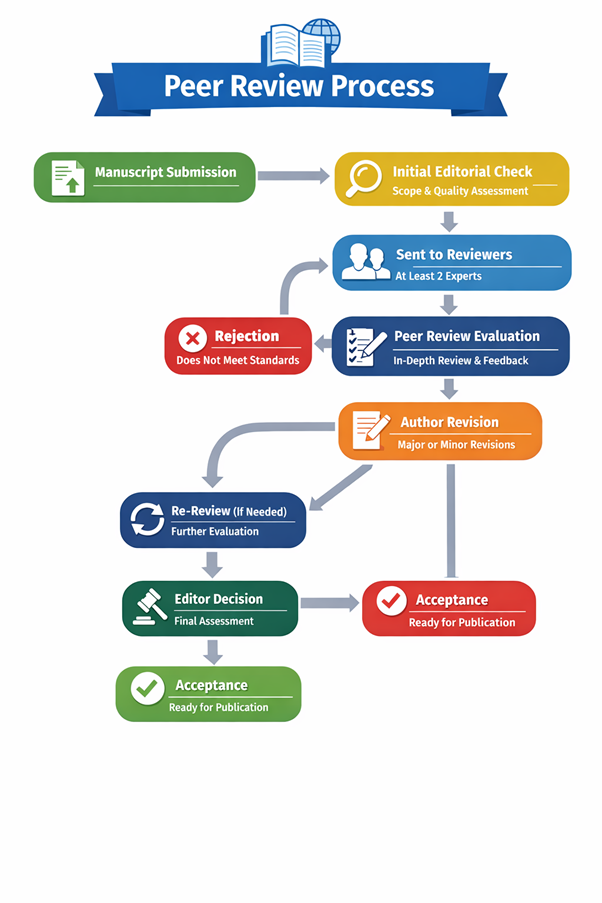
Social Work Reviews: An International Journal operates a single-anonymized peer review, whereby the identities of reviewers are hidden from the authors. All manuscripts submitted to the journal will undergo plagiarism screening using iThenticate or a similar plagiarism detection tool, which is conducted by the in-house editorial team immediately after submission. This ensures originality and academic integrity before peer review begins.
A brief summary of the peer review process for each manuscript is outlined below:
Preliminary Review
Before peer review, the Editorial Office performs an initial assessment of all submissions. Manuscripts may be desk rejected at this stage if they do not align with the aims and scope of Social Work Reviews, lack originality, or fail to meet minimum academic standards. Manuscripts that do not adhere to submission guidelines or ethical requirements may also be rejected without further review.
Peer Review
Each manuscript that passes the preliminary check is sent to at least two independent expert reviewers. Reviewers are selected based on their expertise and lack of conflicts of interest. The peer review process is designed to ensure a thorough evaluation of the manuscript’s scientific quality, methodological rigor, ethical compliance, and contribution to the field of social work.
Author Revision
After receiving sufficient review reports, the Editorial Office will request the authors to revise their manuscript accordingly.
- Major revisions may be returned to the original reviewers for additional evaluation.
- Minor revisions may be reviewed by the Editorial Office or returned to the reviewers depending on the editor’s discretion and reviewer preferences.
In general, a maximum of two rounds of major revision is permitted unless exceptional circumstances apply.
Editor Decision
Final decisions are made by the Editor-in-Chief or an appointed Academic Editor. The editor evaluates:
- The overall scientific merit and originality of the manuscript
- The appropriateness and quality of the reviewers’ evaluations
- The adequacy of author responses and revisions
- Ethical compliance and research integrity
Academic editors must also disclose any potential conflicts of interest that may influence their decision-making.
2. Reviewers’ Profile and Responsibilities
Reviewers play a critical role in ensuring the integrity and quality of academic publishing. Each reviewer is expected to evaluate manuscripts in a timely, transparent, and ethical manner.
Social Work Reviews is committed to rigorous peer review. Reviewers who accept to review a manuscript are expected to:
- Possess the necessary expertise to judge the scientific quality of the manuscript
- Provide comprehensive, objective, and constructive review reports
- Respond promptly throughout the review process
- Maintain professional and ethical standards
Use of AI tools: Reviewers must not use generative AI or AI-assisted technologies to write or enhance peer review reports. Peer review requires critical thinking, expertise, and judgment, which cannot be replaced by AI. Reviewers are fully responsible and accountable for the content of their reports.
3. Review Reports
Reviewers should carefully evaluate the manuscript, including supplementary materials, and provide detailed comments that help authors improve their work.
Review Guidelines
Please consider the following instructions:
- Read the full manuscript and any supplementary files thoroughly.
- Provide detailed comments on each section of the paper, including figures, tables, and methods.
- Ensure your comments are clear and specific, enabling authors to address them accurately.
- Avoid recommending citations of your own work or that of colleagues unless they are essential for the manuscript’s improvement.
- Do not suggest excessive citations of specific journals or authors to manipulate citation metrics.
- Maintain a neutral and respectful tone. Derogatory or personal comments are not tolerated.
For additional guidance on writing review reports, reviewers may refer to COPE guidelines and other peer review resources.
Review Report Structure
Review reports should contain the following sections:
- Summary:
A brief paragraph summarizing the purpose, main contributions, and strengths of the manuscript. - General Comments:
Major issues related to research design, methodology, analysis, ethics, or scope. - Specific Comments:
Line-by-line or section-specific comments, including corrections, clarifications, and suggestions for improvement.
Specific comments should focus on scientific content rather than language or formatting, which can be addressed by the editorial office.
4. Rating the Manuscript
Reviewers should rate the manuscript based on the following criteria:
- Novelty: Is the research original and significant?
- Scope: Is the manuscript within the journal’s scope?
- Significance: Are the results meaningful and justified?
- Quality: Is the manuscript well-written and well-structured?
- Scientific Soundness: Is the research design and analysis rigorous and reproducible?
- Interest to Readers: Will the manuscript appeal to readers of Social Work Reviews?
- Overall Merit: Does the manuscript advance knowledge in the field?
- English Level: Is the language clear and readable?
If reviewers suspect any form of scientific misconduct, including plagiarism or unethical practices, they should immediately report this to the editorial office.
5. Overall Recommendation
Reviewers must provide one of the following recommendations for the next processing stage:
- Accept in Present Form: The manuscript is suitable for publication without changes.
- Accept after Minor Revisions: The manuscript is acceptable after minor revisions.
- Reconsider after Major Revisions: The manuscript requires significant revisions and may be reconsidered after resubmission.
- Reject: The manuscript has serious flaws or lacks originality and will not be considered for publication.
Please note that reviewer recommendations are visible only to editors. The final decision is made by the editorial team.